Fencing
Close boarded, feather edge, panel and post and rail, with posts concreted to a depth that suits the height and the exposure. On coastal boundaries that means deeper than the standard rule of thumb.
Fences, gates, patios, paving and garden walls built on foundations that hold up to coastal wind and wet ground.
Gas Safe registered, FMB members and family-run in Eastbourne.

We handle the construction side of gardens: fencing and gates, patios and paving, paths and steps, decking, garden and retaining walls, drainage, artificial lawn, and the groundwork that all of it sits on. We are builders rather than planting designers, so if you want a planting scheme drawn up we will work alongside your garden designer.
Nearly every outdoor job that fails does so below the surface. Fence posts set too shallow or in soil rather than concrete lean and snap in the first real gale. Paving laid on sand over unprepared ground sinks, rocks and puddles within a couple of years.
So we spend the money where it does not show: dug out and compacted sub base, posts set deep in concrete, falls set so water runs away from the house, and drainage where the ground holds water. It is less satisfying to look at than the paving and it is what makes the difference.
We work across East Sussex for homeowners, landlords and businesses, on single fence runs and on whole gardens rebuilt from the ground up.
Coastal wind is the first problem. Gales off the Channel put real load on a fence, and a close boarded panel acts like a sail. Most of the fences we replace have not rotted so much as been levered over, because the posts were not deep enough or were set in soil.
Salt is the second. It shortens the life of timber, corrodes fixings and gate hardware, and takes the finish off anything that was not treated for exposure.
Then the ground. Much of the area inland is clay, which holds water and moves with the seasons, while parts of the coastal strip have made up ground. Both mean paving needs a thoroughly dug and compacted base and somewhere for water to go, or it will not stay level.
Levels matter as well. Raising a patio against the wall of the house is one of the most common causes of damp we get called to investigate.
Fence posts are concreted to an adequate depth for the height of the fence and the exposure, and we use posts and timber suitable for the position rather than the cheapest available. Gates get hardware that will survive salt air.
Paving and patios are excavated to a sound formation, given a compacted sub base to a depth that suits the use, laid on a full mortar bed where the material needs it, and set to a fall that takes water away from the building and to a soakaway or drain rather than onto a neighbour.
Retaining walls are built to hold what is behind them, with foundations, reinforcement where needed and drainage behind the wall, because a retaining wall without drainage is holding back water as well as soil.
We use our bricklayers for the masonry, and we price the groundwork separately from the finish so you can see both.
Boundaries, hard landscaping, drainage and the groundwork beneath it, on domestic and commercial property.
Close boarded, feather edge, panel and post and rail, with posts concreted to a depth that suits the height and the exposure. On coastal boundaries that means deeper than the standard rule of thumb.
Timber and metal gates, side gates and driveway gates, hung on posts set for the weight and fitted with hardware chosen to survive salt air rather than the cheapest available.
Natural stone, porcelain, block paving and slabs on an excavated and compacted base, laid to a fall away from the building and set below the damp course wherever levels allow.
Including handrails and levels that work for access and for wheelchairs and buggies, and drives built up to take vehicle loading rather than foot traffic.
Garden, boundary and retaining walls with foundations and drainage behind them through our structural works, plus timber and composite decking framed and fixed to last by our carpenters.
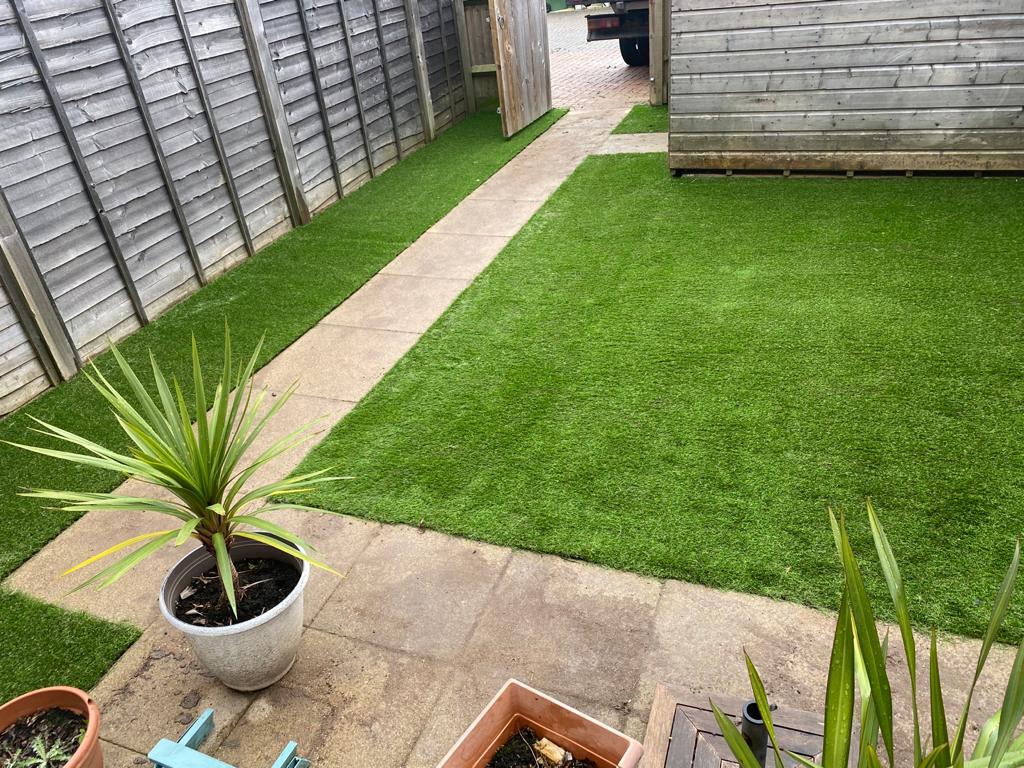
Soakaways, channel drains and levels sorted so water leaves the building rather than pooling against it, and artificial lawn laid on a prepared free draining base.
Fencing is where most neighbour disputes start, and nearly all of them are avoidable by checking a few things first.
We check the heights and the levels before we build, and we will tell you if what you have asked for needs permission. Ring us on 01323 671001 to talk it through.
Estate Agents
As a property company, I have used CB now for a good few years. The service is great, the builders are very knowledgeable and they tidy up after themselves.
Exposure varies enormously across this area, and it changes what a boundary needs. A fence in a sheltered street in Old Town and one on an open plot at Pevensey Bay or above Seaford take completely different wind loads, and the second needs deeper posts, stronger fixings and often a more open construction that lets wind through rather than fighting it.
Ground conditions vary just as much. Inland towards Hailsham, Heathfield and the levels there is heavy clay that holds water and moves seasonally, so paving needs a deeper compacted base and somewhere for water to go. Nearer the coast there is made up ground in places, which needs digging out rather than building on.
Drainage is the thing most often skipped. A new patio is a large area of hard surface that was previously grass, and that water has to go somewhere. Falls to a soakaway or a channel drain matter, and putting it towards the house or a neighbour causes problems that cost far more to correct later.
The damp course is the other local trap. A great many Victorian and Edwardian houses here have a low damp course, and raising a patio against the wall bridges it and puts damp inside. That is one of the causes we find when investigating damp.
As a working rule, about a quarter to a third of the post height in the ground, set in concrete. For a typical 1.8 metre fence that means roughly 600 millimetres, and more on an exposed coastal boundary or for a taller fence and gate posts. Posts set shallow or packed in soil are the main reason fences blow over here.
Usually not up to two metres high, or one metre where it adjoins a highway used by vehicles. Permission is needed above those heights, and rules are tighter for listed buildings, in some conservation areas and where a planning condition restricts boundary treatments. We check before building rather than afterwards.
Your title plan is the place to start, and a T mark on one side of a boundary line usually indicates which property is responsible for it. There is no universal rule about the left hand side despite what people say. Where ownership is unclear it is worth agreeing with the neighbour before work starts, particularly if posts or footings will cross the line.
Almost always because it was laid without an adequate dug and compacted sub base, or on sand over soft ground, or with no fall and nowhere for water to go. Relaying the surface without correcting the base gives you the same result again. We excavate to a sound formation and build the base up correctly, which is most of the cost and all of the reason it lasts.
Yes. A retaining wall holds back soil and water, so it needs a designed foundation, the right thickness and reinforcement for the height, and drainage behind it. Above about a metre, or where it supports a drive or a neighbour’s ground, it needs engineering input, which we arrange through our structural works.
It can, and it is a common cause of damp we are called to investigate. If new paving is laid above the damp proof course, or hard against the wall with no gap or drainage, water bridges into the brickwork. Paving should sit at least 150 millimetres below the damp course where possible, and where levels make that impossible a drainage channel is needed.
It suits some gardens very well, particularly small ones, shady ones where grass struggles, and households that want no upkeep. It has to be laid on a prepared free draining base with edging, or it wrinkles and holds water. It gets warm in strong sun and it does not suit everybody, so we will talk through the trade offs honestly.
Something that lets wind through rather than blocking it. Close boarded panels act like sails and put enormous load on the posts. Hit and miss or slatted fencing with gaps, on posts concreted deeper than standard, survives far better on an exposed plot at Pevensey Bay or Seaford, and a hedge behind it eventually does the rest.
We are based on Hyde Gardens in Eastbourne, so the town and the villages around it are home ground for us. We are out working here most days and we know the housing well, including the older seafront terraces, the Victorian and Edwardian houses in Upperton and Meads, and the newer estates and blocks of flats nearer the edge of town.
From Eastbourne we cover the whole of East Sussex. Along the coast that takes in Bexhill, Hastings, Seaford, Newhaven, Brighton, where salt air and driving rain are hard on any building. Inland we work regularly in Polegate, Hailsham, Pevensey, Willingdon, Lewes, Uckfield, Heathfield, Crowborough, Battle and the smaller villages between them, where period cottages and country properties often need a gentler approach and older materials matched carefully.
Being local matters for fencing and landscaping. We can get to you quickly to take a look, we know the buildings and the ground conditions, and we are never far away if you need us again. If your village is not on the list there is a good chance we still reach you, so give us a call on 01323 671001 and we will tell you either way.
Garden landscaping across East Sussex, including artificial lawn, patios and paving.


We are Gas Safe registered and members of the Federation of Master Builders, NAPIT and the FSB. Those memberships mean our gas, electrical and building work is measured against recognised standards, and that an outside body has looked at how we work rather than us simply saying we are good at it. For a family business our reputation matters more than anything, and we have built it one customer at a time.
Our Accreditations