Bathrooms and shower rooms
Full walls, half heights, splash areas and floors, with tanking to any wet area as standard. Often part of a complete bathroom refurbishment handled by one team.
Bathrooms, kitchens, wet rooms and floors tiled by a family firm that tanks the wet areas before the first tile goes on.
Gas Safe registered, FMB members and family-run in Eastbourne.
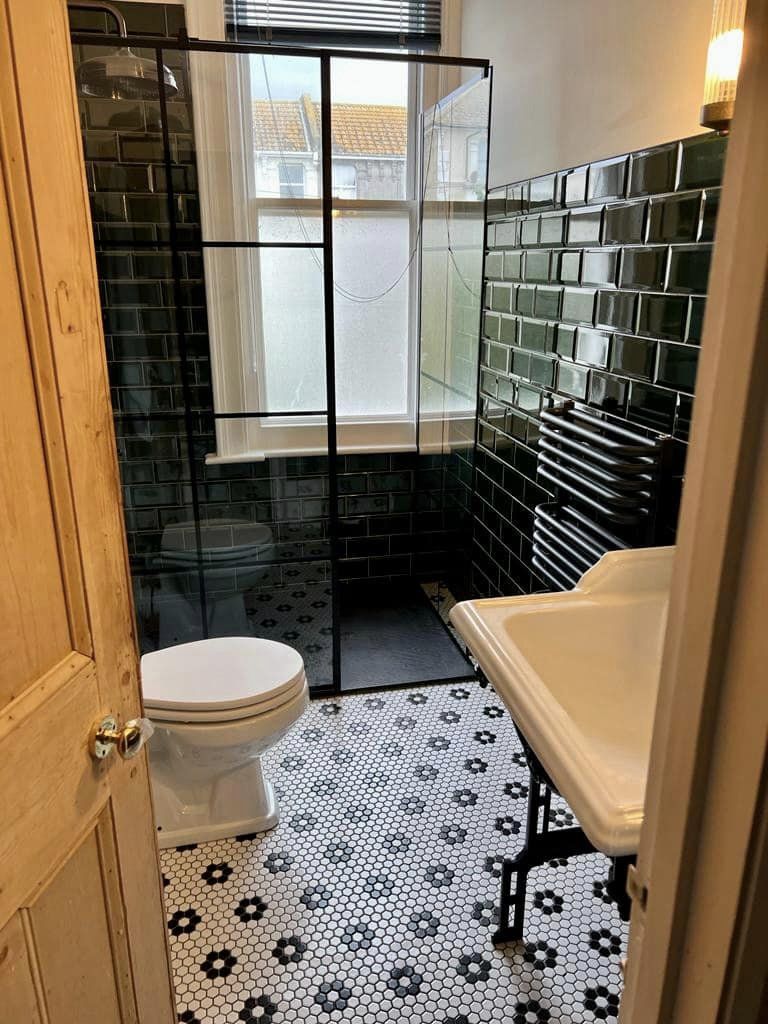
A tiled wall or floor is only as good as what sits behind it. Getting a level and sound background, tanking anything that will be wet, using the right adhesive and movement joints, and sealing the junctions correctly are what stop a bathroom leaking into the room below or a floor cracking along a line in two years.
We tile bathrooms, shower rooms, wet rooms, kitchens, utilities, hallways, porches, conservatories and commercial floors, in ceramic, porcelain, natural stone, metro and mosaic. We also retile after leaks and strip out failed tiling that was never fixed to a sound background in the first place.
Because we also plumb, plaster and fit, a bathroom or kitchen can be handled as one job by one team rather than you coordinating a plumber, a tiler and a plasterer around each other and losing a week between each.
Tanking is the part most people do not know to ask about, and it is the part that decides whether a shower is still sound in ten years. We do it as standard rather than as an upgrade.
Loose and cracked tiles almost always mean a problem behind them. Tiling straight onto old paint or unsealed plasterboard, onto a floor that flexes, or onto a surface that was damp when it was tiled will all end the same way.
In showers and wet rooms the other failure is water. Grout is not waterproof and silicone does not last forever, so if the wall behind was never tanked, water works its way through the joints and into the structure. The tiles look fine while the board behind them turns soft.
On floors, cracked tiles and lines of failed grout usually mean movement, either a timber floor that was not stiffened enough or a screed with no movement joints in it.
And large format tiles on an out of true wall. A wall twenty millimetres out over its length shows badly in a big tile unless it is dubbed out or reskimmed first.
Our tilers prepare the background first, and we will tell you if it is not fit to tile onto. That might mean overboarding, replacing water damaged board, adding noggins to stiffen a floor, or reskimming to get a wall flat.
Anything that will get wet gets tanked. Shower areas, wet rooms and splash zones get a waterproof membrane before tiling, which is not visible when the job is done and is the single most important part of it.
Then we set out carefully so cuts land sensibly rather than a sliver at a door or a corner, use the correct adhesive and trowel for the tile, and finish junctions in silicone rather than grout so they can move without cracking.
We clear up daily and take the waste and the old tiling away with us, which on a strip out is a good deal more material than people expect.
Walls and floors, domestic and commercial, in standard ceramic, large format porcelain, natural stone, metro and mosaic.
Full walls, half heights, splash areas and floors, with tanking to any wet area as standard. Often part of a complete bathroom refurbishment handled by one team.
Fully tanked floors and walls with formers and linear drains, laid to a fall so water goes where it should. We check the floor construction first, because the fall is easier to achieve on timber than on a concrete slab.
Splashbacks, full walls and hard wearing floors, set out around units and sockets so cuts fall sensibly. Fitted alongside our kitchen refurbishment work.
Porcelain, ceramic and stone with the substrate prepared first: floors stiffened, decoupling where needed and movement joints in larger areas so tiles and grout do not crack.
Limestone, slate and marble sealed correctly for where they are going, plus large panels that need back buttering and a flat background, and mosaic and metro work with tight setting out.
Replacing cracked tiles, regrouting and resealing tired bathrooms, stripping out failed tiling, and tiling over electric and water underfloor heating with suitable adhesives.
Most of the tiling problems we are called to start with the tile choice rather than the fitting. A few things are worth knowing before you buy.
Send us what you are considering before you order and we will tell you whether it suits the room and what the background will need.
Client
Colin, Nat and the team carried out the work at a competitive price with the minimum of fuss. Courteous, punctual and could not have been more helpful.
Two things make tiling harder in the housing around here. The first is that walls in Victorian and Edwardian houses are rarely flat or square, so a wall out by twenty millimetres over its length will show badly in a large format tile unless it is dubbed out or reskimmed first. Setting out has to allow for it rather than fight it.
The second is timber floors. Suspended floors move, and tiles do not. Tiling onto boards without stiffening the floor and using a decoupling layer or suitable board is the most common reason we get called to cracked floor tiles, and the fix means taking the floor up rather than replacing the cracked tile.
In flats there is the additional point of what is below you. A shower that has not been tanked is a leak into somebody else’s ceiling, and in a block that becomes an insurance and liability question rather than a repair. It is why we tank as standard, and it matters even more in the converted houses around Eastbourne where the floors between flats were rarely designed for wet rooms.
Hard water is worth mentioning too. Across East Sussex, scale marks and dulls tiled surfaces and shower screens quickly, so a sealer on natural stone and a sensible grout choice make the upkeep far easier.
Yes, as standard. A waterproof membrane goes on before the tiles in any shower enclosure or wet room. Grout and silicone are water resistant rather than waterproof, so without tanking, water gets through the joints over time and into the wall or floor behind. It is hidden work and it is the part that matters most.
Sometimes, if the existing tiles are firmly bonded, flat, and the extra thickness will not cause a problem at door thresholds or with fittings. Often it is not a good idea, because you are trusting the old adhesive to hold both layers and you cannot tank behind them. We will tell you which situation you are in.
Usually movement rather than the tiles being faulty. A timber floor that flexes underfoot, missing noggins, or a lack of movement joints in a large tiled area will all crack tiles or the grout between them. Fixing it means dealing with the floor, not just replacing the cracked tile.
Yes, most customers do. Tell us the size, material and finish you are looking at before you buy and we will tell you whether it suits the room, how much you need allowing for cuts and waste, and whether it needs anything particular in the way of adhesive, sealing or setting out.
Yes. Limestone, marble and slate are porous and stain easily, so they need sealing after fitting and periodically afterwards. In a bathroom or kitchen that matters, and the type of sealer depends on the stone and the finish you want. We tell you what the upkeep involves before you commit to it.
For tiling alone, usually a couple of days plus drying and grouting time. For a full bathroom refurbishment it is longer, and we give you a realistic run of days in the quote. We would rather tell you a week and be right than tell you three days and leave you without a bathroom.
Yes, both electric mat and water systems. It needs flexible adhesive and grout, the system commissioned and tested before tiling, and the heating brought up slowly afterwards rather than switched straight to full output, which is what cracks tiles over new heating.
Yes, and it makes a tired bathroom look considerably better for very little money. We rake out and replace grout, strip and renew silicone at the junctions, and treat any mould. If the tiles behind are loose or the wall is soft, that points at a water problem behind them, and we will tell you if that is what we find.
We are based on Hyde Gardens in Eastbourne, so the town and the villages around it are home ground for us. We are out working here most days and we know the housing well, including the older seafront terraces, the Victorian and Edwardian houses in Upperton and Meads, and the newer estates and blocks of flats nearer the edge of town.
From Eastbourne we cover the whole of East Sussex. Along the coast that takes in Bexhill, Hastings, Seaford, Newhaven, Brighton, where salt air and driving rain are hard on any building. Inland we work regularly in Polegate, Hailsham, Pevensey, Willingdon, Lewes, Uckfield, Heathfield, Crowborough, Battle and the smaller villages between them, where period cottages and country properties often need a gentler approach and older materials matched carefully.
Being local matters for wall and floor tiling. We can get to you quickly to take a look, we know the buildings and the ground conditions, and we are never far away if you need us again. If your village is not on the list there is a good chance we still reach you, so give us a call on 01323 671001 and we will tell you either way.
We are Gas Safe registered and members of the Federation of Master Builders, NAPIT and the FSB. Those memberships mean our gas, electrical and building work is measured against recognised standards, and that an outside body has looked at how we work rather than us simply saying we are good at it. For a family business our reputation matters more than anything, and we have built it one customer at a time.
Our Accreditations