Skimming and patching
Skim coats over existing plaster and new board to leave walls and ceilings flat and ready to paint, plus patching and making good after leaks, removed walls, rewires and new openings, matched into the existing finish.
Flat walls and sound render, inside and out, by plasterers who deal with the cause of the cracking before skimming over it.
Gas Safe registered, FMB members and family-run in Eastbourne.
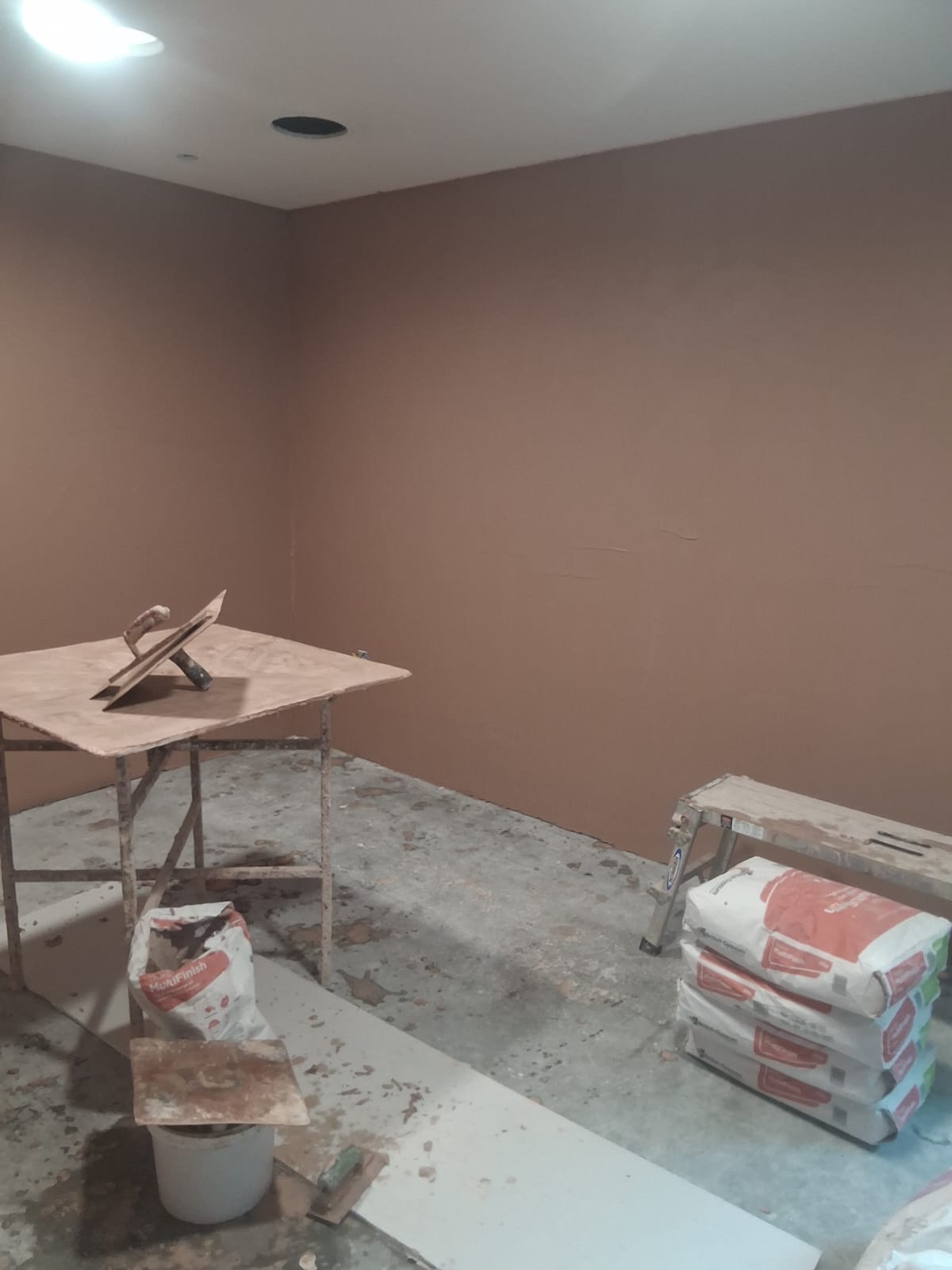
Plastering is the internal finish on your walls and ceilings: skimming, patching, reboarding and float and set work that leaves a flat surface ready to decorate. Rendering is the external coat that protects the outside of the building, in sand and cement, lime, or a modern through coloured or silicone system.
Internally we are usually called because plaster has blown, cracked, or been damaged by a leak or a removed wall. Externally it is because render is cracked, hollow, staining or coming away, which on this coast means water is getting behind it and staying there.
The important part in both cases is what is underneath. Skimming over blown plaster or patching render without finding out why it failed gives you a good looking wall for a season and the same problem back afterwards. We tap the wall and check the background before we quote.
We work on houses, flats, blocks and commercial buildings across East Sussex, including a good deal of solid walled period property where the choice of material matters more than anything else.
Internally, the usual causes are damp, movement and age. Old lime plaster on lath loses its key and starts to sound hollow, gypsum plaster on a damp wall blows and blisters, and new cracks appear where a building has settled or a lintel is working.
Externally, cracked render lets water in and then traps it. Hard sand and cement render on a soft old brick wall is a common problem here, because the wall needs to breathe and the render will not let it. The result is damp inside and render that drums when you tap it.
Coastal weather speeds all of this up. Wind driven rain finds every hairline crack, and salt crystallising behind the surface pushes it off the wall.
Painting over it makes matters worse rather than better, because an impermeable coating seals the moisture in behind the finish.
Our plasterers tap the wall before we quote. Hollow areas have lost their bond and have to come off, and knowing how much is loose is the difference between a patch and a full elevation. We would rather tell you that up front than discover it on day two.
We match the material to the building. Solid walled period property usually wants a lime based render or plaster that lets moisture move, not a hard cement one that traps it. Modern block and board work is different, and we treat it differently.
Then we deal with the cause. That might be a gutter, a cracked sill, a missing bell cast or a damp problem, and we can put those right in the same job so the new finish has a fair chance of lasting.
Plastering is dusty work, so we sheet up, protect floors and doorways, and clear up at the end of each day rather than the end of the job.
Internal and external, modern and traditional, including patches after leaks and full elevations in lime render.
Skim coats over existing plaster and new board to leave walls and ceilings flat and ready to paint, plus patching and making good after leaks, removed walls, rewires and new openings, matched into the existing finish.
Overboarding tired ceilings, dot and dab or timber battened board on solid walls, and repairs to lath and plaster ceilings that have lost their key rather than pulling them down where they can be saved.
Full two coat work where plaster has been hacked off back to brick or block, including after damp treatment, with beads and angles set out so corners and reveals are straight afterwards.
Breathable lime finishes for solid walled and period property, applied in coats and protected while curing. Slower and more work than gypsum or cement, and the correct material on a building that has to breathe.
Sand and cement, through coloured and silicone systems, plus crack repair, beading, bell casts and stop beads so water is thrown clear of the wall instead of tracking back into it. See external refurbishment.
Repairing and matching cornice and coving in period rooms, including taking a mould from surviving sections so a replacement run matches rather than replacing the lot with modern coving.
You can get a long way towards the answer yourself before we arrive, and it is worth doing because it changes the scale of the job considerably.
Send us photos of the wall and of whatever is above it outside, and we can usually tell you what we are dealing with before we come out.
Estate Agents
As a property company, I have used CB now for a good few years. The service is great, the builders are very knowledgeable and they tidy up after themselves.
A great deal of the housing between Eastbourne and Lewes is solid walled, built in soft brick, flint or stone with lime mortar and no cavity. Those walls were designed to take up moisture and let it out again, and they work well as long as nothing stops them doing it.
Cement render and modern gypsum plaster both stop them doing it. Water gets in through a crack, cannot evaporate through the hard surface, and moves sideways and inwards instead. That is why so many period houses with cement render have damp inside and hollow render outside at the same time, and why replacing like with like keeps the problem going.
On those buildings we use lime, which is more work to apply and slower to cure but keeps the wall doing what it was built to do. It also moves with the building rather than cracking away from it, so small seasonal movement does not open up a fault every year.
On modern cavity walled construction, cement and silicone systems are usually the better choice and lime would be the wrong answer. Knowing which building is in front of us is most of the job, and it is why we ask about the age and construction before quoting.
Tap it. Render that sounds hollow has lost its bond and will keep coming away even if the cracks are filled, so that section has to come off. Render that is sound but cracked can usually be cut out, repaired and recoated. We tap the whole elevation when we quote and tell you what proportion is actually loose.
Almost always because the wall behind it is damp, or because gypsum plaster has been used on a solid wall that needs to breathe. Replastering without dealing with the moisture will give you the same result again. We look for the source first: a gutter, a bridged damp course, failed pointing or condensation.
Fresh plaster needs to dry before it takes paint, and how long depends on thickness, time of year and ventilation. As a rule allow several days for a skim coat and considerably longer for full float and set work or lime. It should be an even colour with no dark patches, and the first coat wants thinning as a mist coat so it binds.
Yes. We use lime plaster and lime render on solid walled and period property, including repairs to lath and plaster ceilings. It takes longer to apply and cure than gypsum or cement, and on a building that needs to breathe it is the correct material and it prevents damp problems later.
Usually yes. Original cornice and coving can often be repaired in place, and where a section is missing we can take a mould from what survives or match it with the closest available profile. In a period room it is worth doing rather than replacing everything with modern coving.
Usually yes. Where artex is sound it can be skimmed over after preparation, which is cheaper and far less messy than removing it. Where it is loose it has to come off first. Artex applied before the mid 1980s can contain asbestos, so it should be tested before anyone sands or scrapes it, and if it does we would overboard or skim rather than disturb it.
Plastering is dusty and wet work, so we sheet floors and furniture, mask doorways to stop dust travelling through the house, and clear up daily. Waste goes with us. We also tell you which days are the wet ones, because rooms need ventilation and time to dry afterwards.
Yes. We apply render systems over external wall insulation, which is a sensible option on a solid walled house that is cold and already needs rendering. It needs the right beads, reveals and detailing around windows and at the roof edge, and it changes the wall thickness, so it is worth planning rather than adding as an afterthought.
We are based on Hyde Gardens in Eastbourne, so the town and the villages around it are home ground for us. We are out working here most days and we know the housing well, including the older seafront terraces, the Victorian and Edwardian houses in Upperton and Meads, and the newer estates and blocks of flats nearer the edge of town.
From Eastbourne we cover the whole of East Sussex. Along the coast that takes in Bexhill, Hastings, Seaford, Newhaven, Brighton, where salt air and driving rain are hard on any building. Inland we work regularly in Polegate, Hailsham, Pevensey, Willingdon, Lewes, Uckfield, Heathfield, Crowborough, Battle and the smaller villages between them, where period cottages and country properties often need a gentler approach and older materials matched carefully.
Being local matters for plastering and rendering. We can get to you quickly to take a look, we know the buildings and the ground conditions, and we are never far away if you need us again. If your village is not on the list there is a good chance we still reach you, so give us a call on 01323 671001 and we will tell you either way.
We are Gas Safe registered and members of the Federation of Master Builders, NAPIT and the FSB. Those memberships mean our gas, electrical and building work is measured against recognised standards, and that an outside body has looked at how we work rather than us simply saying we are good at it. For a family business our reputation matters more than anything, and we have built it one customer at a time.
Our Accreditations